 Socialist Party Wales Socialism In Wales
NHS workers across Wales and the UK were on the march today for a pay rise. There were protests in Cardiff, Swansea, Merthyr and Bridgend. Below Beth Webster a nurse at UHW hospital Cardiff explains the anger at the government’s refusal to increase pay.
Cardiff

Over 500 angry nurses, NHS staff and supporters gathered outside the Wales Millenium Centre, for a march to the Senedd to rally for an immediate 15% pay increase for NHS workers.
In spite of the leaderships of Unison and RCN having done nothing to build for the event, there was a clear mood to fight against years of real-terms pay cuts, and the UK and Welsh governments’ chronic mishandling of the Covid-19 crisis.
Speakers at the rally included Socialist Party members Beth Webster, a nurse on the front line of the pandemic and fighter against low pay and poor working conditions in the NHS, and Katrine Williams brought solidarity from Cardiff Trades Council.
Swansea
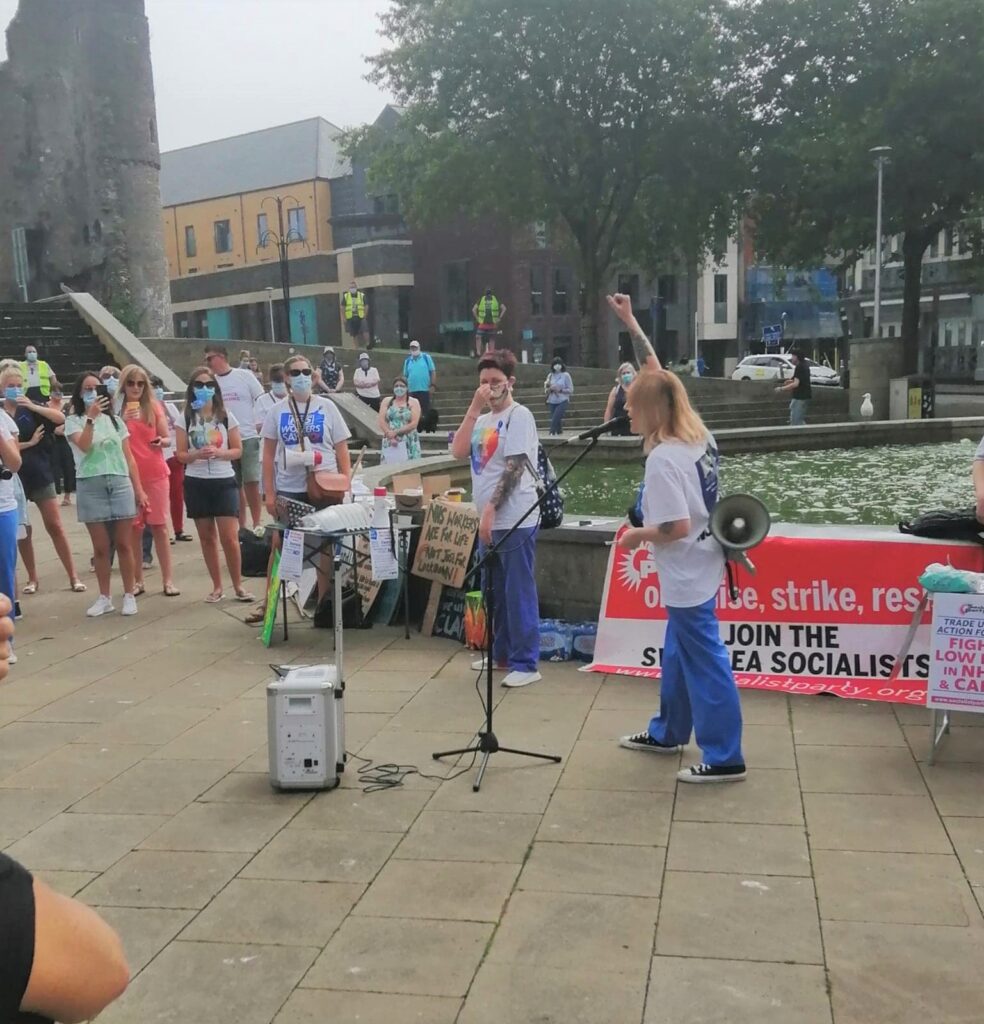
Instead of heading to the sun drenched Gower coast 4-500 protesters turned out to an inspiring city centre rally in support of NHS, care and essential workers demand for an immediate pay rise.
Alongside rank & file nurses, one Labour MP & MS, five Socialist Party members addressed the rally including one of our youngest and oldest members!
There was loud applause to our demands that the health unions, in particular the Unison leadership, officially take up this fight now, instead of boycotting and undermining these magnificent, spontaneous protests. ‘The fight is just beginning’ was the rallying call from the Swansea organisers!
Merthyr

An energetic crowd of 300 – mainly nurses – marched through Merthyr Tydfil this afternoon to demand a 15% pay rise.
The slogan of the march was “Be Fair to those who Care” – and the demo organisers pointed out that the demo was part of something much larger: nurses were marching in town centres all over the country.
Nurses wore NHS t-shirts. The mood was lively and confident. At the end of the march, one of the nurses read out a poem about the sacrifices that nurses were making in the pandemic.
Beth Winter, MP and Mick Antoniw, MS spoke. The event was stewarded by Merthyr Trades Council. People eagerly took Socialist Party placards.
Bridgend
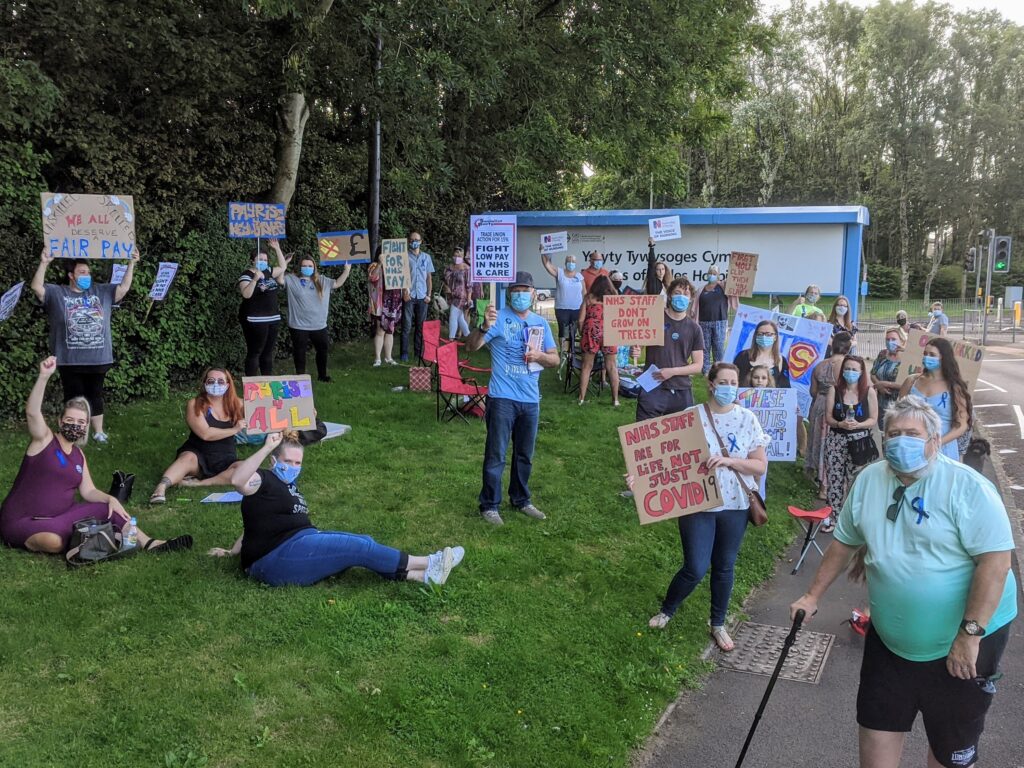
Over 50 NHS workers and supporters gathered to protest for a pay rise at the Princess of Wales hospital, Bridgend.
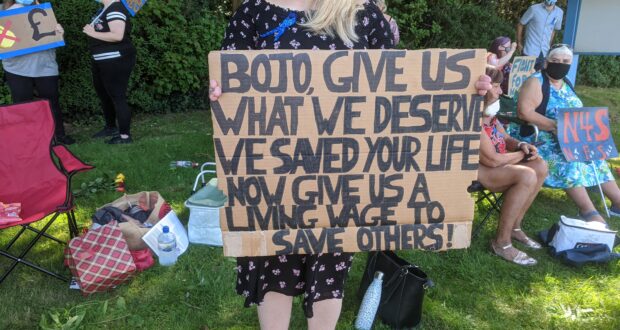
The overwhelming mood was of anger against Boris Johnson, who’s own life was saved by the NHS, does not think that now is the time to discuss a pay rise for nurses. One placard read: “Bojo give us what we deserve. We saved your life, now give us a living wage to save others!
Also there was a concern to defend the NHS itself with home-made placards stating “N4S – Not For Sale”.

Beth Webster explains:
NHS workers are infuriated that many of us are not receiving decent pay increases this year.
We remain in the middle of a gruelling battle against Covid-19, and are facing a second wave, yet still we have to struggle to afford the basics. We’ve had enough. A national day of action has been called with protests in over 30 towns and cities on 8 August.
The government’s excuse for leaving nurses, porters, junior doctors, cleaners and other essential workers out of the pay deal is that we are already tied into a three-year deal. But that is a below-inflation ‘rise’ and many NHS workers have seen their wages cut by 20% in real terms since 2010.
With over 42,000 nursing vacancies in England and Wales, a recent Royal College of Nursing poll showed a third of nurses are considering quitting, and low wages are the main reason. Some nurses were using food banks even before the pandemic, and the Covid crisis has thrown up extra costs for health workers, such as childcare.
Some nurses I work with are facing £600 and more a month in childcare costs as their parents are shielding and unable to help. So we are not calling for a decent pay rise because we deserve it (although we do!) but because we need it.
Added to the financial strain has been the physical and psychological toll on health workers. Around 540 health workers have died during the pandemic – the highest number in Europe and third-highest in the world.
We experienced PPE and equipment shortages, were redeployed to unfamiliar and incredibly stressful areas, and separated from loved ones to protect them. We looked after other critically ill health workers in, at times, inadequate PPE, worried we’d be next to get ill.
Little seems to have changed to prevent these things happening again in a second wave. We remain under immense pressure as we restart services while keeping patients safe.
We urgently need to take action. The Thursday claps showed we have fantastic public support, but the actions of the government since prove that’s not enough.
We need to get ourselves organised. The leaders of our unions have bitterly disappointed us, but some branches with combative members and reps have won safer conditions for members during the pandemic.
If we want to continue the fight beyond the protests, we must turn all union branches into fighting ones. The travesty of our union leaders backing a below-inflation deal can’t happen again.
The grassroots NHS pay campaign calls for our unions to immediately reopen pay talks, for a fully funded 15% pay rise for all NHS workers, and for mass union meetings to engage members in the pay battle and prepare for industrial action.
There are concerns among NHS workers that we can’t ask for pay rises while others are facing wage cuts and redundancies.
But we shouldn’t have to choose between decent wages for us or jobs for others. The money is there to fund our pay rise.
For example, the Welsh government gave nursing agencies £69 million last year. Nurses often work agency shifts on top of their full-time NHS hours to top up their wages, or because they need flexible hours for their families.
But NHS ‘bank’ work doesn’t pay enough. Why not use that money to raise NHS nurses’ wages and ensure flexible working is available within the NHS?
It’s not money that’s lacking, it’s political will. We should link up with other workers and fight all wage cuts and redundancies in both the public and private sector.
There are also concerns that if we need to take industrial action, it will negatively impact patient care, but look how it’s being impacted now when we don’t take action!
Fightbacks
Nurses struck in Ireland last year for better wages. Home carers in Birmingham and Glasgow have won strikes in recent years for fair wages. Lewisham hospital workers successfully struck at the beginning of the pandemic in a wage dispute with an outsourcing firm. All these enjoyed huge public support.
The coronavirus pandemic and the fight for fair pay have raised other vital issues. The care sector crisis shows a nationalised care service is long overdue. It has highlighted the dangers of privatisation, with private firms refusing to provide PPE for their workers.
It has also highlighted huge inequalities such as racism within the NHS and wider society: around 60% of health workers who died were black, Asian and minority ethnic.
This battle is about more than pay. Our experiences in the pandemic show that we cannot leave the NHS and social care sector in this government’s hands.
But we cannot leave the pay battle in our current union leaders’ hands. Look at the courage lay members have shown during the pandemic: these are the people we need at the head of our unions and our NHS.
We need public ownership, and democratic control by health workers and communities, of health and social care. These protests are only the beginning.
A socialist programme for the NHS should include:
- An immediate 15% pay rise for all health and care staff including those in privatised sectors Minimum wage of £12 an hour – £15 in London. Scrap zero-hours contracts immediately
- Reverse all privatisations. Scrap the ‘Private Finance Initiative’ and cancel all PFI debts
- Bring all outsourced workers and services in-house on a permanent contract
- A fully publicly funded NHS and care system, free at the point of use. Scrap prescription charges in England, dental charges and all health charges
- Nationalise the private healthcare sector, care homes, the medical supply industry and the pharmaceutical companies – integrate them into the NHS
- Reinstate student bursaries and scrap tuition fees in England
- We can’t trust pro-privatisation, pro-austerity, anti-working-class politicians
- Fight for the building of a new mass workers’ party
- Unite and fight the institutionalised racism of the bosses. Black Lives Matter!
- A socialist NHS – democratically run by elected and accountable committees, including service workers and users
- A socialist planned economy to end oppression, poverty and inequality