 Socialist Party Wales Socialism In Wales
By Dave Warren, Swansea Trades Council and PCS (personal capacity)
As we enter the month of October, 15 of the 21 Welsh counties with over 2.3 million people are subject to local COVID restrictions. Already, as of 30 September there have been 24,383 recorded cases and 1,622 deaths even according to the sanitised official figures and this is while the second wave is still at an early stage.
This picture essentially mirrors what has happened in the UK as a whole. There is a certain perception in Wales that the Welsh Government has generally handled the crisis better than its UK counterpart and it is true that restrictions were lifted at a slightly slower pace over the summer than in England with the appearance of placing greater emphasis on public safety. However, the big issue that exposed this fallacy was the insistence of the Welsh Government that schools should return fully from the start of September without the safety measures demanded by the teaching unions.
The truth is that the measures taken in Wales have varied only marginally from those taken across the border. The same fundamental shortcomings of failure to take measures early enough, failure to provide PPE even for front line health workers and the total shambles of the test and trace provisions have been apparent throughout the UK. The parallel response to the crisis has resulted in approximately similar results in terms of the infection rate and death rate.
What has been the response of the trade union movement in Wales? Unfortunately, they have completely failed to stand up and criticise the Welsh Government’s response to the crisis.
The teaching unions appeared to be taking a firm stance on safety, by opposing the re-opening of schools unless adequate measures were put in place to protect pupils and staff. However, the return to school has not been opposed in practice, with parents left to make personal decisions and teachers left to deal with any local problems without the benefit of a co-ordinated trade union response. The unions raised criticisms initially but then remained silent as teachers were forced to return to work in unsafe conditions.
It’s not as if working people have been unwilling to fight. The past few months have seen huge protest movements. The Black Lives Matter protests were the largest anti – racism protests that many towns and cities have experienced in living memory. Following on from that we had rank and file health workers organising large rallies and demonstrations for a 15% pay rise. Then school students forced a u – turn by both the UK Government and Welsh Government on exam results. Now, an explosion of anger is brewing in the universities as students are confined to their student accommodation and paying full fees and rents for nothing but on-line tuition.
Although trades councils and individual trade unionists have been strongly in evidence, none of these movements were led by or significantly supported by the leadership of the trade unions. In Swansea for example, the BLM protest was organised by two local young women with the support of the trades council and attracted over 1,000 mainly young, mainly working – class people. Similarly, nurses in Swansea organised a march of over 600, again supported by the trades council, but banners and speakers from their trade union, UNISON were conspicuous by their absence.
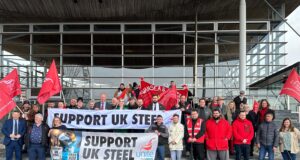
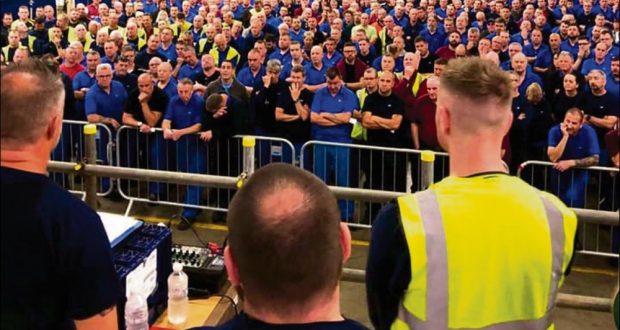
The COVID crisis has been accompanied by economic crisis, exemplified by the closure of the Ford engine plant in Bridgend. While UNITE raised verbal protests and was active in preparing workers to face this devastating change in their lives, e.g. by providing training on how to claim universal credit, there was little sign of a serious attempt to fight the closure.
This absence of leadership is more than unfortunate, because the trade unions are still the largest and most powerful organisations representing the working class and still have the potential strength to defend workers and force concessions from the bosses and from Governments.
Instead, some union meetings have not even gone ahead during the pandemic, at just the time when workers need leadership more than ever. The Wales TUC had already reduced its annual congress to a two – yearly event but it has not had its scheduled congress this year, even on a virtual basis.
Just like their counterparts throughout the UK, the union leaders in Wales have largely been drawn into social partnership arrangements with the Welsh Government and employers. In Wales, it has not just been a case of falling for the con – trick that “we are all in it together”, but there is also the fact that the major unions are tied politically to the Welsh Labour Government and are reluctant to make any criticisms.
The ending of the job retention (furlough) scheme threatens an unemployment crisis on a scale not witnessed for generations. The substitute offered by Rishi Sunak would still leave workers with a massive pay cut. Now is the time for the unions to go onto a war footing to ensure that workers are not made to pay for the crisis.
The National Shop Stewards Network (NSSN) has called for the TUC to organise a day of action on the 24th October to demand the continuation of the scheme but based on work or full pay. The Wales NSSN will be holding a virtual rally on that day to involve and draw upon the experiences of workers and youth who have taken part in the protest movements over the summer.