 Socialist Party Wales Socialism In Wales
Ele Jane, Cardiff East Socialist Party
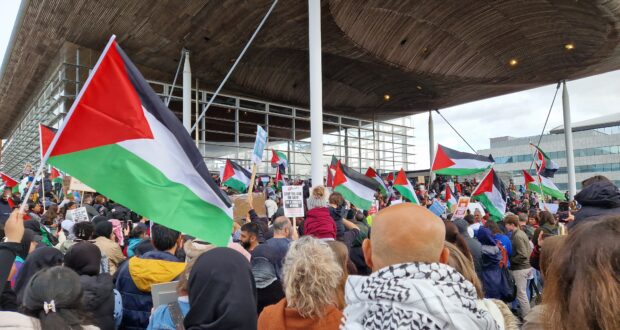
Between 3 and 4 June, 19 protesters were arrested in Cardiff and Swansea in a brutal escalation of police response to the Palestine movement. A video shows eight police officers surrounding a disabled activist, and forcing his head down, before escorting him away.
An emergency demonstration was called in response outside Cardiff Bay police station – 15 people partaking in a non-violent sit-in inside were arrested. They were released 19 hours later. The disabled activist was released after 26 hours.
South Wales police also arrested a 12-year-old and their Palestinian mother the next day during a protest in Swansea for alleged assault. There is outrage at this claim. The 12-year-old was placed in a cell, and a supporter of the couple was later arrested.
This was a targeted attack on the anti-war movement, and an escalation of police tactics. The scenes at the police station were brutal and unnecessarily violent.
Ruling class
The ruling class use the police to stamp down in times of unrest. During the miners’ strike 1984-85, over 11,300 miners and their supporters were arrested. Over 5,600 stood trial, and over 100 jailed.
Supporters were intimidated or victimised into losing their jobs. For about £500,000 a day, Margaret Thatcher, then Tory prime minister, strategically used the police to try and intimidate the miners into submission (see page 14).
We need democratic control of the police, where the community decides staffing and operations. There would be no room for racism and hate.
Capitalism creates war and division, we fight to spread the ideas of socialism as a path to justice.
Trade union delegation to Cardiff protest camp
By Jonathan Golding, Unite Community and Cardiff Trades Union Council delegate, personal capacity
Cardiff Trades Union Council made a solidarity visit to the Cardiff University Gaza protest camp, led by members of the Socialist Party. It included local representatives from the NEU, UCU, PCS, Unison, and Unite trade unions.
It was an educational experience for everyone, in which the students’ experience of protesting in support of Palestinian rights could be seen in the wider context of working-class struggles to end all forms of oppression. The role of trade unions in that struggle was explored, with many people participating in the discussion, particularly how properly organised trade union action and workers’ sanctions could help bring an end to the slaughter in Gaza.
Another topic covered was the marketisation of education – the running of universities like businesses, instead of as an educational service. Students, especially those from overseas, have to take on massive loans to fund their education, which discourages poorer and working-class students from even considering higher education.
The pressing need to form links between student protests and the organised working class in trade unions was also highlighted. For example, by students being invited to speak at union branches and at trades union council meetings, as well as by visits like ours!

