 Socialist Party Wales Socialism In Wales
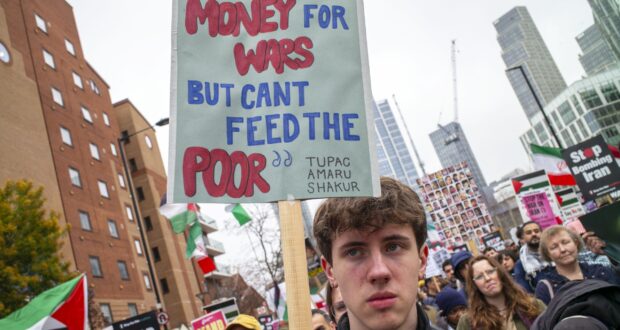
Editorial of the Socialist issue 1358
US and Israeli missiles are continuing to rain down on Iran, with thousands killed. The Iranian regime is in turn still firing at targets across the Middle East. Fifteen countries have so far been hit by one side or the other, with an estimated 7.5 million people living within 1km of a missile or drone strike. Israeli troops have reinvaded southern Lebanon. Brutal repression of the Palestinians in Gaza and, increasingly, the West Bank continues unabated.
Donald Trump and Benjamin Netanyahu are not motivated to end the suffering of the Iranian people heroically struggling against its theocratic dictatorship. Netanyahu wants to further reconfigure the Middle East in the interests of Israeli capitalism and at the same time increase his chances of winning the Israeli general election.
Trump too, was partially motivated by distracting workers at home from his growing unpopularity. Trump seems to have imagined he could easily repeat a version of what the US did in Venezuela in January, using force – this time on a much greater scale – to bludgeon a section of the Iranian regime into doing the US’s bidding. That achieved, Trump would not give a damn for the continued suffering of the Iranian population.
At this stage, however, Trump’s schemes have come to nothing, and the bombing continues across the Middle East. The implosion of the Iranian regime, were that to happen, would be very unlikely to produce a new stable regime which would do the bidding of US imperialism! But ‘regime change’ via an air campaign alone has never been achieved, yet for the US to commit ground troops in any numbers would be a domestic political disaster for Trump.
It is reported that the US is attempting to arm different national minorities and encouraging them to take on the Iranian regime, giving air cover to Kurdish fighters crossing the border from Iraq, although it is not clear how widely it is taking place. This is utterly cynical by Trump. US imperialism, and British imperialism before it, has always been willing to abandon different peoples fighting for their national rights when supporting them is no longer useful to their imperialist interests. Remember how, at the end of the first Gulf War in 1990, having encouraged the Shias and Kurds to rise up against Saddam Hussein in Iraq, US, British and French forces stayed in Kuwait and allowed them to be slaughtered by the Iraqi regime.
As the negative consequences of the war for US imperialism mount up, Trump is under increasing pressure to try and find the ‘off ramp’. However the war develops, increased suffering for the working class and poor in the region, and growing instability and turmoil, are guaranteed. Nor is there any prospect of the conflict bringing greater security for the working class in the US and Europe. On the contrary, it will fuel a new wave of terrorism.
The oil price surged past $100 a barrel, and the financial markets have been sliding in fear of the economic blowback from the conflict. And before the full economic consequences hit workers’ pockets, this war is unpopular. According to opinion polls, only 26% of Americans support it, an unprecedented low in the first week of a conflict started by the US. Far from distracting from Trump’s problems at home, this conflict will enormously add to them.
Consequences in Britain
It is also making Keir Starmer’s difficulties even greater. He is already hated, with Labour trailing behind the Greens and Reform in the polls.
Britain’s bond, or government debt, market has so far been hit among the hardest by the global turmoil. That in turn will increase the pressure from the capitalist elite for the government to inflict more austerity on the working class. At the same time, the prospect of increasing stagflation is posed – as the economy stalls while inflation surges.
And on the war itself, Starmer has managed to annoy everyone and please no-one. That he did not initially ask ‘how high?’ when Trump said ‘jump’ reflects two things. First the decline of the power of US imperialism. It is still the strongest power on the planet – not least militarily – but it no longer sets the framework for the world. In this increasingly multipolar world every capitalist power has no choice but defend its own interests, rather than simply follow the lead of the US.
The other factor, however, which explains why Starmer initially took a slightly more critical stance than German chancellor, Merz, for example, was the large scale of the anti-war movement here. That has been reflected in the size of the biggest Gaza demos, but also in the way voters, particularly those from a Muslim background, broke with Labour in the general election – resulting in the four ‘Gaza’ Independent Alliance MPs being elected, alongside Jeremy Corbyn.
In the Denton and Gorton by-election that same mood was expressed in a vote for the Greens. Labour is facing a catastrophe in the local elections, and Starmer knew – with two thirds of the population against Trump’s attack on Iran – uncritical support for it could only have made that worse. Of course, voters are going to be able to see that Starmer’s few words of mild-mannered criticism of Trump do not alter one iota the reality the government is supporting US imperialism’s bombardment of Iran. RAF jets have been used to shoot down drones, and US planes involved in the conflict are flying from RAF Fairford in Gloucestershire.
What tasks for the working class?
At this stage, looking on at the nightmare being suffered by the masses of the Middle East, the predominant feeling of most workers and young people in Britain is powerlessness; an understandable feeling that there is nothing we can do to stop Trump and the other warmongers, nor to aid the working class and poor in Iran facing a brutal dictatorship and US missiles.
But we are not powerless. Even now, Starmer’s mealy-mouthed criticism of Trump reflects the power of the anti-war movement. In the US, the mass working-class opposition to ground troops being deployed is a major factor curtailing Trump’s options. At the end of last year, general strike action in Italy on the question of Gaza was one of the factors that pushed Trump to ‘end’ the conflict – although of course the horror continues in a different form.
The working class, in Britain and internationally, is a potential super-power. We are organised in trade unions in our millions in our workplaces. Collectively we are the force which keeps society running and which makes profits for the capitalists. Collectively, we also have the power to overturn this sick capitalist system, and build a democratic socialist society. To achieve that, however, our class needs to get organised as an independent force.
Back in 2011, the Middle East was the centre of the world’s attention for a different reason. A mass movement of the working class and poor demonstrated our class’s huge power in action. It swept the region overthrowing dictatorships. Ultimately, however, those movements were defeated and dictatorships restored, because the working class of the different countries lacked their own parties with a programme to break with this rotten capitalist system and build a new socialist society. A society based on peaceful cooperation rather than imperialist war and where science, technique and technology would be harnessed to meet the needs of all rather than used for the profits of the billionaires. Today the masses of the Middle East, not least in Iran, face the same task as they did back then.
And so do we. The most important solidarity we can bring to the working class and poor in the Middle East – and to those opposing Trump and ICE in the US – is to build the movement against our own capitalist class, and the politicians that do their bidding, here in Britain. Building a new mass workers’ party that stands for socialism and internationalism is a crucial step in that struggle.
Socialist Party says
- The trade unions should call a weekend demo uniting the struggles against war, racism and austerity
- Students and youth get organised in schools and campuses and protest to fight for a future free from war
- Fight to build a new mass workers’ party that stands for socialism and internationalism, including by building for the widest-possible stand of socialist anti-war, anti-austerity candidates in May’s elections against all the warmongers
- Capitalism means war. Fight for socialist change – nationalise big business and the banks under democratic working-class control to carry out a socialist plan of socially useful production to meet the needs of all
- Fight for a socialist world, including for a voluntary socialist confederation of the Middle East, with full rights for minorities


